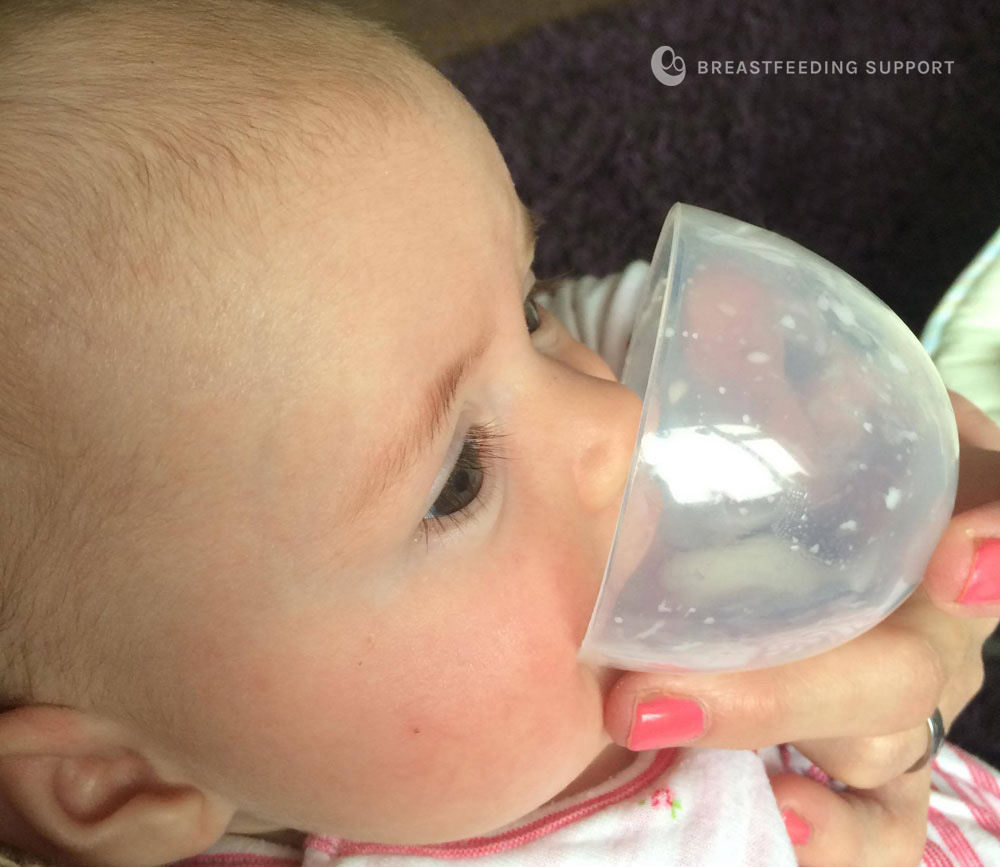
Cup feeding is an alternative to bottle feeding if a baby can’t latch to the breast and needs to be given some milk. It can also be used for supplementing a baby who is not getting enough milk or for a baby who is separated from his mother for a while. It is thought to be a useful short-term alternative to using a bottle teat as it avoids a baby getting confused by the different sucking action required on an artificial bottle nipple (nipple preference/confusion). However, there are disadvantages as well as advantages to cup feeding. This article looks at the pros and cons of cup feeding and how to cup feed a newborn baby.

Pros and cons of cup feeding
Advantages of cup feeding
- Better oxygen saturation and heart rate. A premature baby can feed at his own pace which may improve his oxygen saturation and heart rate making him more physiologically stable1Penny et al. Cup Feeding as a Supplemental, Alternative Feeding Method for Preterm Breastfed Infants: An Integrative Review. Matern Child Health J. 20182Rocha et al, Cup or bottle for preterm infants: effects on oxygen saturation, weight gain, and breastfeeding, 20023Marinelli et al, A comparison of the safety of cupfeedings and bottlefeedings in premature infants whose mothers intend to breastfeed, 2001
- Cup feeding may help preserve breastfeeding by avoiding bottles. Studies show cup feeding premature babies instead of using bottles can increase the number of babies who breastfeed and increase the length of time they breastfeed4Collins et al. Avoidance of bottles during the establishment of breast feeds in preterm infants. Cochrane database of systematic reviews. 20165Penny et al. Cup Feeding as a Supplemental, Alternative Feeding Method for Preterm Breastfed Infants: An Integrative Review. Matern Child Health J. 2018
- Cup feeding can prepare a baby for breastfeeding. Feeding technique (use of muscles) while cup feeding is thought to be closer to breastfeeding than using a bottle6Franca et al. Electromyographic analysis of masseter muscle in newborns during suction in breast, bottle or cup feeding. BMC Pregnancy and Childbirth volume 14, 2014 and may help prepare a baby for breastfeeding by encouraging the tongue to come forward for lapping/sipping
- Open cups are easily available, inexpensive and very easy to clean in resource poor areas or emergencies—compared with teats, bottles or feeding tubes
- Suitable for very young babies. Cup feeding can begin from as early as 29 weeks gestational age7Gupta et al, Cup feeding: an alternative to bottle feeding in a neonatal intensive care unit, 1999 and may improve breastfeeding rates in late preterm babies 8Flint et al. Cup feeding versus other forms of supplemental enteral feeding for newborn infants unable to fully breastfeed. Cochrane Database Syst Rev. 2016.
Disadvantages of cup feeding
- There is a risk of aspiration (inhaling the milk instead of swallowing it) or choking if cup feeding is not done correctly
- Not suitable for sleepy babies due to the risk of choking
- Feeds can take a long time
- There can be a lot of spilled and wasted milk compared with bottle feeding or tube feeding 9McKinney et al, Feeding Neonates by Cup: A Systematic Review of the Literature, 2016
- Long term cup feeding can dampen the sucking reflex or create a preference for the cup.
Can cup feeding help preserve breastfeeding?
One review found cup feeding had no significant benefit in maintaining breastfeeding after discharge from hospital and that the length of hospital stay was likely to be a lot longer with cup feeding for lower gestational age preterm infants (Flint et al, 2016). However more recent studies have found the opposite —more cup fed babies were exclusively breastfeeding at discharge, and beyond, with no apparent increase in hospital stay for term10McKinney et al, Feeding Neonates by Cup: A Systematic Review of the Literature, 2016, late preterm11Yilmaz et al, Effect of cup feeding and bottle feeding on breastfeeding in late preterm infants: a randomized controlled study, 2014 and premature babies (Penny et al. 2018). The Academy of Breastfeeding Medicine12ABM Clinical Protocol #3: Supplementary Feedings in the Healthy Term Breastfed Neonate, Academy of Breastfeeding Medicine, Revised 2017 states cup feeding may help preserve breastfeeding and the World Health Organisation recommends cups or spoons rather than bottles and teats for premature babies13Protecting, Promoting and Supporting Breastfeeding in Facilities Providing Maternity and Newborn Services, WHO, 2017.
How to cup feed a baby
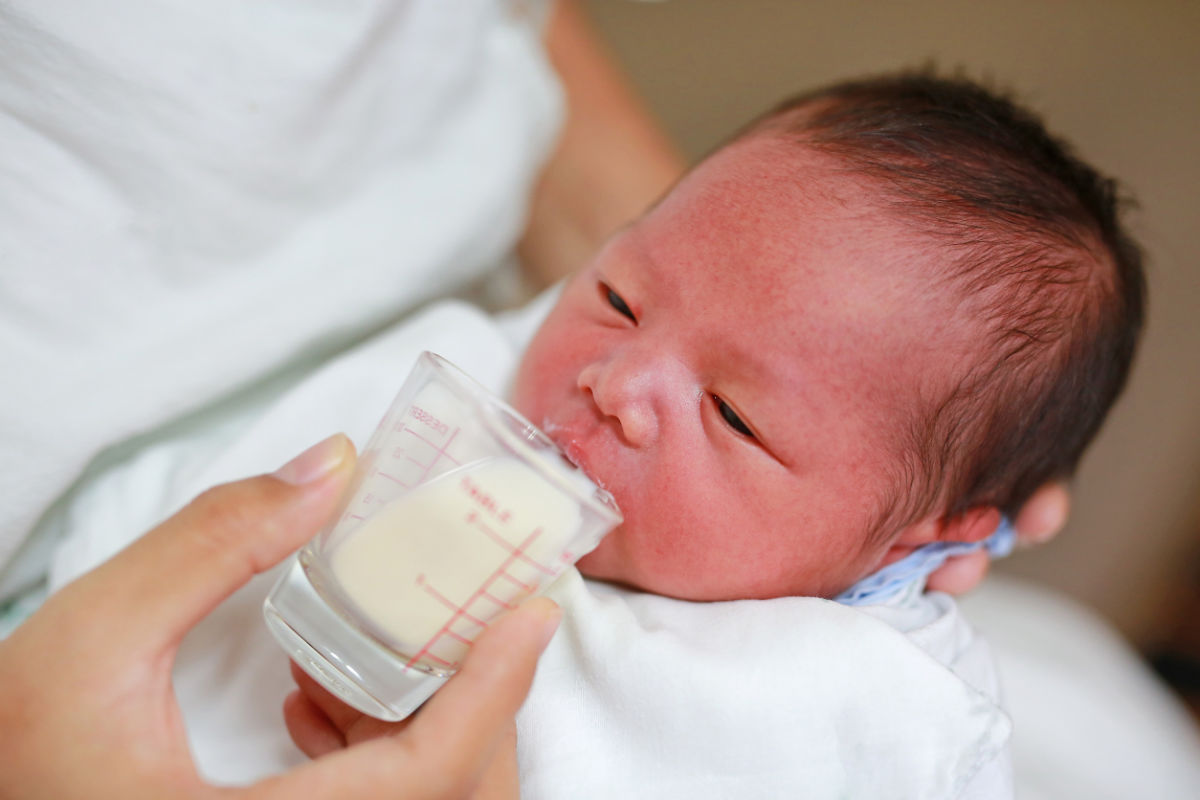
Cup feeding is best taught by a demonstration from your experienced health care professional if possible. They will advise you whether the technique is suitable for your baby. A baby needs to be awake, alert and in an upright position to cup feed. Never cup feed a sleepy baby or a baby who is lying flat and never pour milk into a baby’s mouth as these all increase the risk of your baby choking.
Cup feeding videos
Global Health Media has a lovely series of videos about breastfeeding. The first clip below (9 minutes long) discusses how to safely cup feed a small baby who isn’t breastfeeding yet and includes spoon feeding, using a paladai (see below) and using a nifty cup:
Cup feeding description
The following description is summarised from the video above. Use a small cup with a smooth edge such as a medicine cup, sherry glass or shot glass—your maternity hospital may give you one. You can also buy little plastic cups specially for the purpose which can be shaped slightly during feeding. You may need a cloth under baby’s chin in case any milk spills.
- Half fill or two thirds fill a small cup with slightly warmed breast milk or infant formula
- Ensure your baby is fully awake, alert and interested in feeding. Never cup feed a sleepy baby
- If needed, wrap your baby to prevent him knocking the cup out of your hands
- Sit your baby in a comfortable, upright position on your lap. Never cup feed a baby who is lying flat on their back
- Rest the rim of the cup lightly on your baby’s lower lip or their lower gum ridge
- Tip the cup just enough so that milk reaches the rim of the cup, don’t put the cup too far into baby’s mouth
- Your baby will quickly learn to sip or lap milk from the rim of the cup with his tongue
- DO NOT pour the milk into his mouth, go slowly always keeping the milk just at the rim of the cup
- Leave the cup in position when baby pauses to rest between swallows and is not drinking, avoid putting pressure on the lower lip
- Continue to tip the cup enough to keep the milk at the rim of the cup resting lightly on baby’s lower lip
- Burp baby if needed during the feed.

Short film clips of cup feeding
In the following short clip from Global Health Media, a premature baby is cup feeding. Notice how the baby’s tongue extends to lap the milk.
Jack Newman is a Canadian paediatrician and breastfeeding expert. Here is a clip of cup feeding from his International Breastfeeding Centre:
Using a paladai
Mothers in India have used a small spouted cup called a paladai for centuries. One study compared the use of a bottle, cup and a paladai in 100 newborn babies. Infants took the most milk in the least time and stayed calmest with the paladai 14Malhotra et al, A controlled trial of alternative methods of oral feeding in neonates, 1999. However a 2007 pilot study comparing the paladai with bottle feeding in preterm infants found increased spillage, longer feed times and more stress cues.15Aloysius & Hickson, Evaluation of paladai cup feeding in breast-fed preterm infants compared with bottle feeding, 2007

Alternatives to cup feeding
Alternatives to cup feeding for the breastfed baby who needs supplementing include:
- Supplementing at the breast. A breastfed baby who is latching well to the breast but who needs additional milk can be supplemented while they are breastfeeding by way of a small feeding tube alongside the nipple. The free end of the feeding tube is placed in a container of milk and provides milk when baby suckles with a good seal around breast and tube. For much more information about the pros and cons of this system see Supplementing at the Breast.
- Finger feeding. Finger feeding is another method of providing supplemental milk to a breastfed baby by way of a feeding tube as described above. In this case the feeding tube provides additional milk while the baby suckles on a clean finger. For more information on the pros and cons of finger feeding see What is Finger Feeding?
- Bottle feeding. A traditional way to provide supplemental milk is by bottle and teat. Feeding from an artificial teat has a number of differences to breastfeeding which could cause nipple preference or confusion in some babies. However there are several ways to reduce the differences to help preserve breastfeeding, see Tips to Bottle Feed a Breastfed Baby and Best Bottle for a Breastfed Baby?
Summary
Used correctly, cup feeding can be a useful way to give a newborn baby supplementary milk for short term feeding. Other options for supplementary feeds include using a supplemental nursing system at the breast, or a bottle using our tips to minimise nipple confusion. Your breastfeeding specialist or health professional can help you decide which option is best for you and your baby.
Further reading
- ABM Clinical Protocol #3: Supplementary Feedings in the Healthy Term Breastfed Neonate Academy of Breastfeeding Medicine, 2017
- Cup Feeding Versus Other Forms of Supplemental Feeding Cochrane Database, 2010
- Protecting, Promoting and Supporting Breastfeeding in Facilities Providing Maternity and Newborn Services WHO, 2017
- What is Finger Feeding? Breastfeeding Support, 2025
Footnotes & References
- 1Penny et al. Cup Feeding as a Supplemental, Alternative Feeding Method for Preterm Breastfed Infants: An Integrative Review. Matern Child Health J. 2018 ↩︎
- 2
- 3
- 4Collins et al. Avoidance of bottles during the establishment of breast feeds in preterm infants. Cochrane database of systematic reviews. 2016 ↩︎
- 5Penny et al. Cup Feeding as a Supplemental, Alternative Feeding Method for Preterm Breastfed Infants: An Integrative Review. Matern Child Health J. 2018 ↩︎
- 6Franca et al. Electromyographic analysis of masseter muscle in newborns during suction in breast, bottle or cup feeding. BMC Pregnancy and Childbirth volume 14, 2014 ↩︎
- 7
- 8Flint et al. Cup feeding versus other forms of supplemental enteral feeding for newborn infants unable to fully breastfeed. Cochrane Database Syst Rev. 2016 ↩︎
- 9McKinney et al, Feeding Neonates by Cup: A Systematic Review of the Literature, 2016 ↩︎
- 10McKinney et al, Feeding Neonates by Cup: A Systematic Review of the Literature, 2016 ↩︎
- 11
- 12ABM Clinical Protocol #3: Supplementary Feedings in the Healthy Term Breastfed Neonate, Academy of Breastfeeding Medicine, Revised 2017 ↩︎
- 13
- 14Malhotra et al, A controlled trial of alternative methods of oral feeding in neonates, 1999 ↩︎
- 15Aloysius & Hickson, Evaluation of paladai cup feeding in breast-fed preterm infants compared with bottle feeding, 2007 ↩︎